r-io suiter-io suiteLive semantic contract
Back to documentation
Core · Domains · Extensions

Metamodel, Domains & Extensions

Understand the common graph grammar, its four business domains plus the technical Core domain, and the eleven installable vocabulary extensions found in the source tree.

01 · Authoritative reference

Live complete metamodel

This diagram is loaded from its permanent Nexus URL, so the documentation always displays the latest published version.

Live r-io suite metamodel class diagram served by Nexus
Live diagram served by NexusOpen the SVG at its original address ↗
02 · Concepts

Node types

Every declared concept is listed below. The visual is the default representation defined by the source metamodel when one exists.

VisualTypeLayerNatureDirect propertiesPurpose

39 types. Abstract rows define reusable contracts and are not instantiated directly. Property counts cover declarations made directly on the type; inherited properties remain available at runtime.

03 · Relations

Edge types

Every declared relation type is listed below. The miniature arrow reuses the stroke color defined by its edgeMetaModeling section.

VisualTypeLayerPurpose

34 declarations. Has exists in both the collaborative and system layers with a distinct scope. The live diagram can show the same label several times for different source/target combinations.

04 · Semantic layers

Four business domains, one grammar

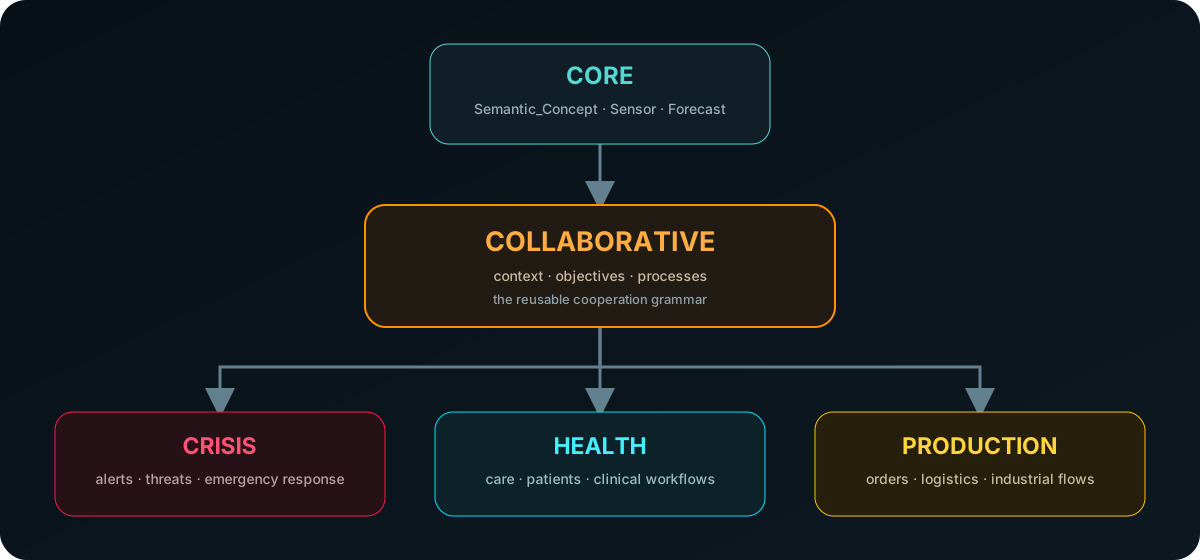
A domain is not a separate data model. It inherits the common semantic contract and adds a focused vocabulary for a family of operational situations. Core itself is a registered technical domain (Core_Domain.xml) that supplies the observation primitives; the four cards below are the business domains built on top of it.

Inheritance from Core to Collaborative, Crisis, Health and Production
Inheritance is cumulative: each specialized domain keeps the collaborative concepts, properties and legal relations.
DOMAIN RESOLUTION
CoreCollaborativeSelected business domainProject model

At load time, the effective model is composed in this order. A Crisis project can therefore use Person, Resource, Objective or Process while adding its Alert specializations.

05 · Optional vocabulary

Extensions: concrete concepts, inherited behaviour

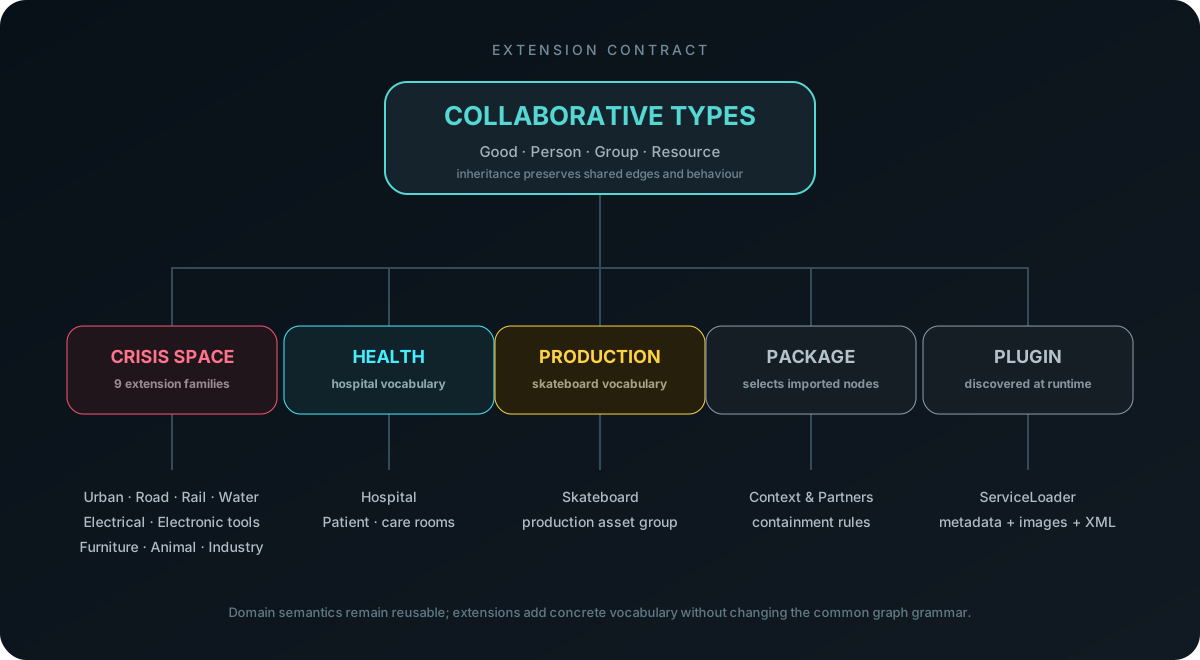
Each extension supplies a descriptor, a metamodel, a package, a runtime plugin and its official visual assets. Its concepts specialize generic collaborative types.

How extensions connect to domains and collaborative types
The privileged domain indicates the natural catalog placement; the inheritance link determines graph compatibility.

11 extensions discovered in gind-models-extension

extension descriptor*_Extension.xml
+
semantic definitions*_MetaModel.xml
+
visible palette*Package.xml
+
runtime discoveryMETA-INF/services

Important: an extension does not merely change an icon. Its inheritance rules make each concrete concept behave like a standard collaborative node—for example, Building and Parking inherit Good, while Patient inherits Person.