
A task waiting for its actor to accept it delays every task after it: the curve starts rising as soon as the first task is not accepted on time. This is wanted, the waiting is a delay.
Critical path slack
When will the process end, given what the field tells now? The strategy projects the end of the process along its critical path and compares it with the deadline of the objectives. It warns while there is still time to react: when the delay has eaten a share of the margin, before the deadline is missed.
implemented byCriticalPathSlackStrategy · gind-npm-strategy-supervision-critical-path-slack
01 · Projection
The critical path with the field progress
The tasks are propagated along the nominal flows of the process (gateways and events take no time); each task starts once all the tasks before it are over.
| Task in the To-Do List | Projected end |
|---|---|
| Done or in error | Its Achieved Date. |
| Going on | max(acceptance + expected duration, now). |
| Not started | max(end of the tasks before it, now) + expected duration: it cannot start in the past. |
| Rejected, cancelled, or on a branch not taken | Takes no time. |
The planned end is the same propagation with the expected durations only, from the start of the supervision. The projected end is the latest end of all the nodes.
02 · Deadline
From the objectives, or a margin
Deadline of the objectives — the plan of an objective (the Plans edge from the objectives manager) can carry an expected latest end date (approximate date) or an expected end date (fixed date). The latest of these dates is the deadline of the whole process.
Default margin — when no objective gives a date, the deadline is the planned end plus 20 % of the planned duration of the process: a process planned for 60 minutes must end within 72.
03 · Score
The share of the margin consumed
margin = deadline − planned end
delay = projected end − planned end (0 when ahead)
consumed = delay / margin (when the deadline is already passed: 1 + overrun / planned duration)
Wrong = consumed / (threshold %) threshold 80 %: Wrong = 1 when 80 % of the margin is gone
delay = projected end − planned end (0 when ahead)
consumed = delay / margin (when the deadline is already passed: 1 + overrun / planned duration)
Wrong = consumed / (threshold %) threshold 80 %: Wrong = 1 when 80 % of the margin is gone
On IMT Albi Crisis, five minutes after the start, the first task accepted late and still going on pushes the end 2 min 12 s later: 30 % of the 7 min 24 s margin is consumed, Wrong = 0.37. The contribution reads “Projected end 15:09:28 against planned end + 20 % margin 15:14:40 (planned end 15:07:16): 2 min 12 s late, 30 % of the margin consumed”.
04 · Parameters
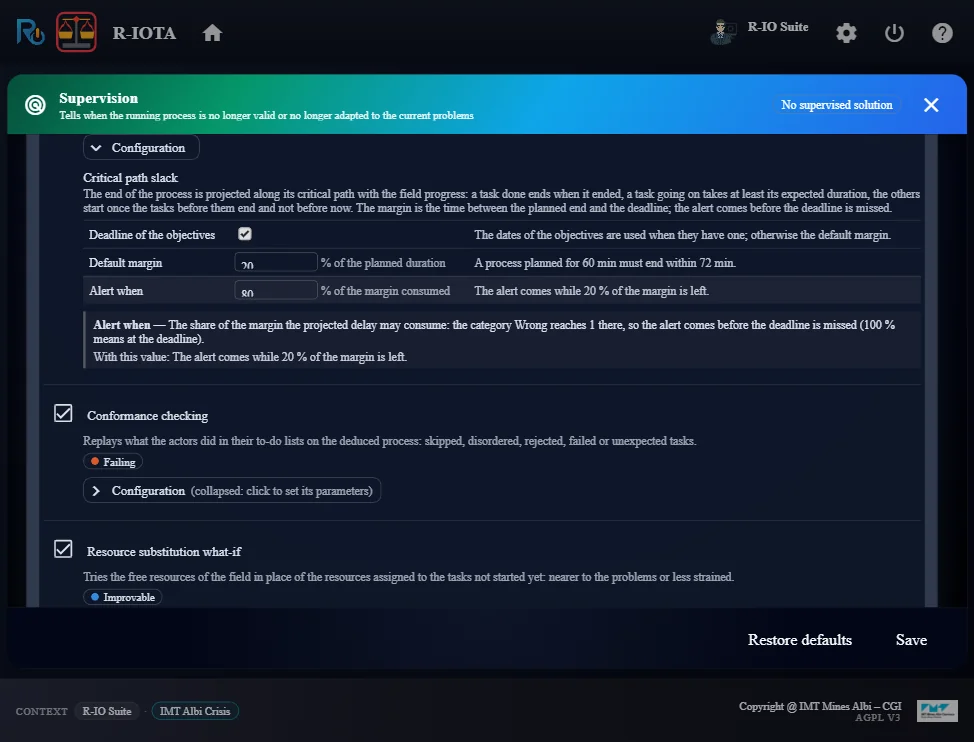
In the supervision box
| Parameter | Default |
|---|---|
| Deadline of the objectives | used when they have one |
| Default margin | 20 % of the planned duration |
| Alert when | 80 % of the margin is consumed |
05 · Watch points
Good to know
With several dated objectives, the whole process is compared with the latest deadline, not objective by objective.
gind-detection-engine-critical-path-slack-strategy/…/CriticalPathSlackStrategy.javaProjection, deadline, share of the margin.gind-webapp-r-iota/…/supervision/SupervisionEngine.javaReading of the dates of the Plans edges of the solution.