r-io suiter-io suitesupervision docs
← Supervision
Supervision / Strategy 06 · unchecked by default

Resource substitution what-if

The deduction chose the actors and goods it knew. Since then, a firefighter may have arrived on site, a colleague may have become available. For each task nobody started yet, the strategy tries every such newcomer in place of an assigned resource and measures the gain. A large enough gain makes the solution Improvable: it still works, a new deduction would do better. It never raises a red alert.

implemented byResourceSubstitutionStrategy · gind-npm-strategy-supervision-resource-substitution
01 · Candidates

Who could replace whom

For each task of the solution which will run and that nobody started yet, for each resource assigned to it (Assigned_To) still on the field, a field instance is a candidate when it:

ConditionWhy
has the same concept as the assigned resource, or a sub-conceptA person replaces a person, a vehicle a vehicle.
is not used by a remaining task of the solutionIt is free: the plan does not count on it already.
has a role in common with the assigned person (Has → Role), when the person has rolesThe deduction assigned the task through a role.
is Available (presence), when it has a presenceBusy, Offline, Do not disturb or Be right back cannot take a task.
is a newcomer: absent from the baseline, or Available now and not at the startThe deduction already chose among the resources it knew.
02 · Gain

Nearer, or less strained

place = center of the problems the solution treats
distance = (d(assigned, place) − d(candidate, place)) / d(assigned, place) × 100
strain = (strain(assigned) − strain(candidate)) / strain(assigned) × 100
Improvable = max over the substitutions of best gain / minimal gain (only a gain ≥ minimal gain counts)

For instance, John arrives 100 m from the gas leak while Emily, assigned to “Cut off the school gas supply”, is 5 km away: a 98 % gain, Improvable = 3.3, “John could replace Emily on "Cut off the school gas supply": 98 % nearer to the problems (100 m against 5.0 km)”. The radar button gets a blue badge and a light banner suggests to find solutions to compare.

03 · Parameters

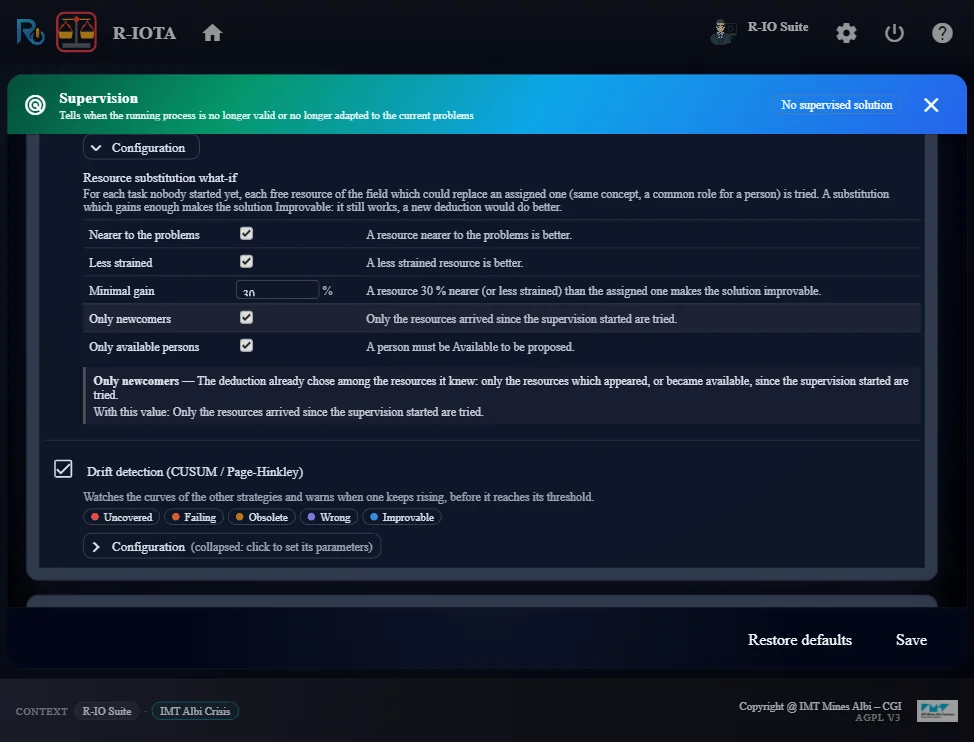
In the supervision box

ParameterDefault
Nearer to the problemsyes
Less strainedyes
Minimal gain30 %
Only newcomersyes
Only available personsyes
Parameters of the resource substitution strategy
Unchecking “Only newcomers” tries every free resource, even those the deduction did not choose.
04 · Watch points

Good to know

Started tasks are kept

A task already accepted keeps its actor: only the tasks nobody started yet are tried.

A gone resource is not a substitution

An assigned resource absent from the field is a failure (Weighted Graph Distance, Failing), not an improvement.

Not shown live yet

The IMT Albi Crisis timeline brings no newcomer: the behaviour is covered by tests with a person arriving near the problem, known from the start, of another role or busy.

gind-detection-engine-resource-substitution-strategy/…/ResourceSubstitutionStrategy.javaCandidates, gains, contributions.
gind-webapp-r-iota/…/supervision/SupervisionEngine.javaRoles of the persons (Has) read for the context.
Supervision / Stratégie 06 · décochée par défaut

Resource substitution what-if

La déduction a choisi les acteurs et les biens qu’elle connaissait. Depuis, un pompier est peut-être arrivé sur le site, un collègue s’est peut-être libéré. Pour chaque tâche que personne n’a commencée, la stratégie essaie chacun de ces nouveaux venus à la place d’une ressource affectée et mesure le gain. Un gain suffisant rend la solution Improvable : elle fonctionne, une nouvelle déduction ferait mieux. Elle ne lève jamais d’alerte rouge.

implémentée parResourceSubstitutionStrategy · gind-npm-strategy-supervision-resource-substitution
01 · Candidats

Qui pourrait remplacer qui

Pour chaque tâche de la solution qui sera faite et que personne n’a commencée, pour chaque ressource qui lui est affectée (Assigned_To) encore sur le terrain, une instance du terrain est candidate quand elle :

ConditionPourquoi
a le même concept que la ressource affectée, ou un sous-conceptUne personne remplace une personne, un véhicule un véhicule.
n’est utilisée par aucune tâche restante de la solutionElle est libre : le plan ne compte pas déjà sur elle.
a un rôle en commun avec la personne affectée (Has → Role), quand la personne a des rôlesLa déduction a affecté la tâche par un rôle.
est Available (presence), quand elle a une présenceBusy, Offline, Do not disturb ou Be right back ne peuvent pas prendre une tâche.
est un nouveau venu : absente de la référence, ou Available maintenant et pas au débutLa déduction a déjà choisi parmi les ressources qu’elle connaissait.
02 · Gain

Plus proche, ou moins fatigué

lieu = centre des problèmes traités par la solution
distance = (d(affectée, lieu) − d(candidate, lieu)) / d(affectée, lieu) × 100
fatigue = (fatigue(affectée) − fatigue(candidate)) / fatigue(affectée) × 100
Improvable = max sur les substitutions de meilleur gain / gain minimal (seul un gain ≥ gain minimal compte)

Par exemple, John arrive à 100 m de la fuite de gaz alors qu’Emily, affectée à « Cut off the school gas supply », est à 5 km : un gain de 98 %, Improvable = 3,3, « John could replace Emily on "Cut off the school gas supply": 98 % nearer to the problems (100 m against 5.0 km) ». Le bouton radar prend une pastille bleue et un bandeau discret propose de chercher des solutions pour comparer.

03 · Paramètres

Dans la boîte de supervision

ParamètreDéfaut
Plus proche des problèmesoui
Moins fatiguéoui
Gain minimal30 %
Seulement les nouveaux venusoui
Seulement les personnes disponiblesoui
Paramètres de la stratégie de substitution de ressource
Décocher « Only newcomers » essaie toutes les ressources libres, même celles que la déduction n’a pas choisies.
04 · Points d’attention

Bon à savoir

Les tâches commencées sont gardées

Une tâche déjà acceptée garde son acteur : seules les tâches que personne n’a commencées sont essayées.

Une ressource disparue n’est pas une substitution

Une ressource affectée absente du terrain est un échec (Weighted Graph Distance, Failing), pas une amélioration.

Pas encore montrée en direct

La frise d’IMT Albi Crisis n’amène aucun nouveau venu : le comportement est couvert par des tests avec une personne qui arrive près du problème, connue dès le début, d’un autre rôle ou occupée.

gind-detection-engine-resource-substitution-strategy/…/ResourceSubstitutionStrategy.javaCandidats, gains, contributions.
gind-webapp-r-iota/…/supervision/SupervisionEngine.javaRôles des personnes (Has) lus pour le contexte.