One garden, one story, three endings. A child, Henri, walks to a lit barbecue, then to an open pool. r-iosemit plays the story and only reads the state of the field to choose its tracks; r-iota, depending on how it is set, does nothing, reacts to the alerts, or anticipates them. Played three times, the same scenario ends with a dead child, a child saved by his mother, or an accident that never happens, and r-iosemit compares the runs.
What this scenario demonstrates
The story is not a fixed list of events. It holds forks: at a given date, r-iosemit reads the state of a resource or the position of a person in r-io and takes the matching track. Nothing tells the story what r-iota decided: it only sees what happened on the field. If the barbecue has been put out, Henri does not get burned, because the track where he does is not taken.
On the r-io side, everything is deduced from the sensors by 2L rules and CEP rules: danger zones, risks whose probability follows the distance, then alerts. With the auto mode, r-iota treats each new alert without a human and gives each task to the closest actor; with extrapolation, it sees the danger coming from Henri’s trajectory, before he gets there.
The clock times below are those of the three reference runs delivered with the scenario: expect a few seconds of difference from one run to the next.
01 · Step
Open the project and read the scenario
The Barbecue project models a garden: a house, a barbecue with a thermal sensor, a swimming pool whose cover has a sensor, the parents Paul and Julie, and their child Henri, who carries a phone with a GPS and a watch with a cardiac rhythm sensor. The story starts on one common trunk, then forks three times, each fork inside a track of the previous one.
In r-ioga, load Barbecue from the Projects workspace, then open Project List.
Launch r-iosemit and r-iota from the Applications column of the project row, and keep both open for the whole scenario.
In r-iosemit, select the game scenario Henri Barbecue Story, open the TIMELINE mode and choose its tree view.
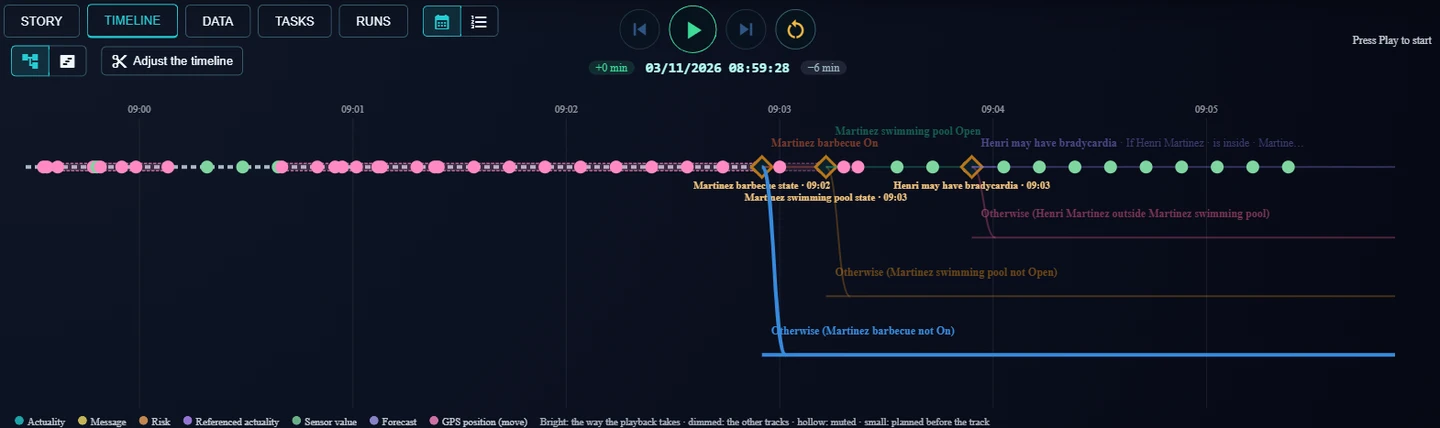
The tree of the scenario: the trunk, then three nested forks (diamonds), each with its track and its Otherwise track.
ResultThe timeline goes from 08:59:28 to 09:05:53, with no stop. Three questions decide the ending: at 09:02:55, Martinez barbecue state (is the barbecue on?); at 09:03:13, Martinez swimming pool state (is the pool open?); at 09:03:54, Henri may have bradycardia (is Henri inside the pool?). The RUNS mode already holds the three reference runs.
02 · Step
First run: nobody watches
Without supervision, r-io still computes the risks and the alerts, but nothing is done about them. Paul leaves the living room, opens the cover of the pool, lights the barbecue, then walks to the back of the garden. The barbecue is On as soon as its thermal sensor reads above 0: each state declares the effect observed on the field, and r-io deduces the state from it. The rules draw a danger zone of 6 m around the lit barbecue and of 10 m around the open pool.
In r-iota, click the radar button of the toolbar: the Supervision dialog opens. Turn Supervision off and click Save.
In r-iosemit, click Play: name the run, choose Continuous at ×1440, a Deduction and deployment time given at 10 s, and tick Simulated actors do their tasks on their own.
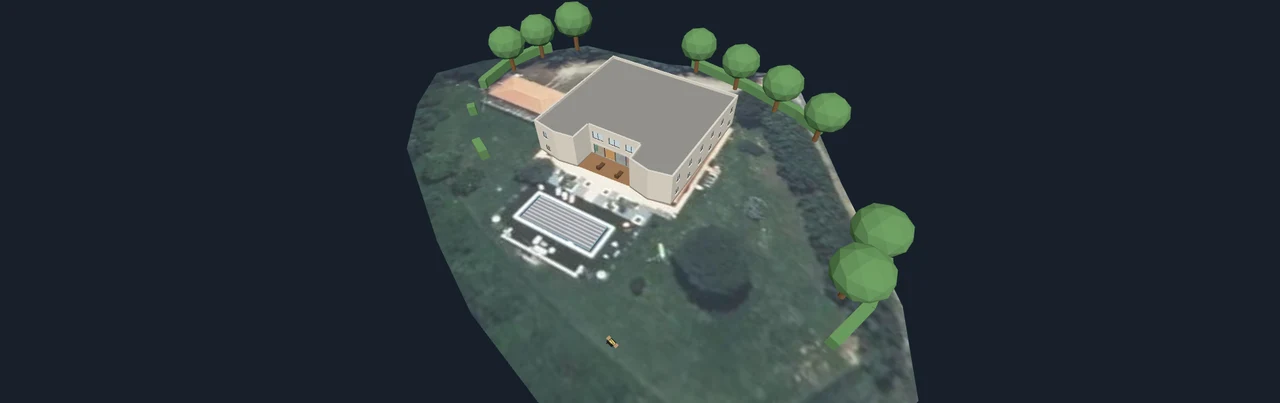
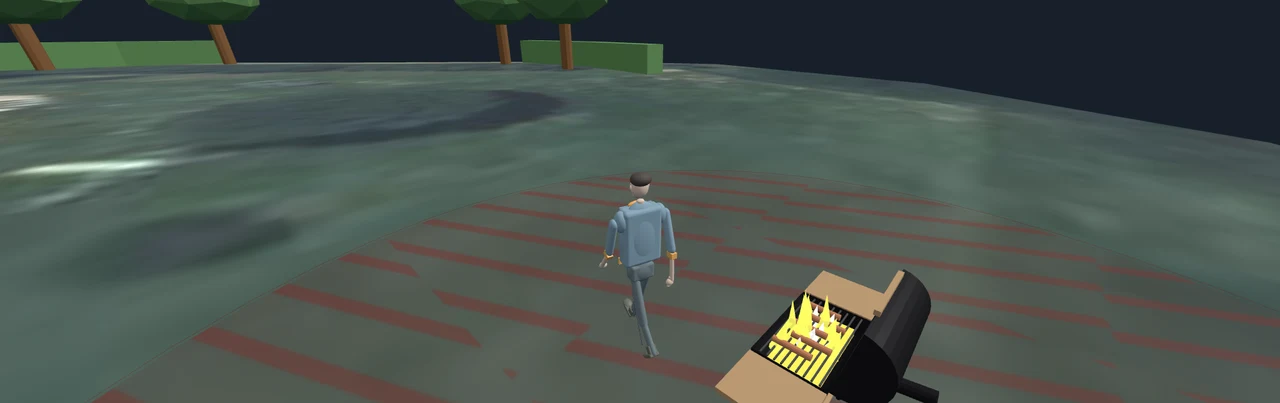
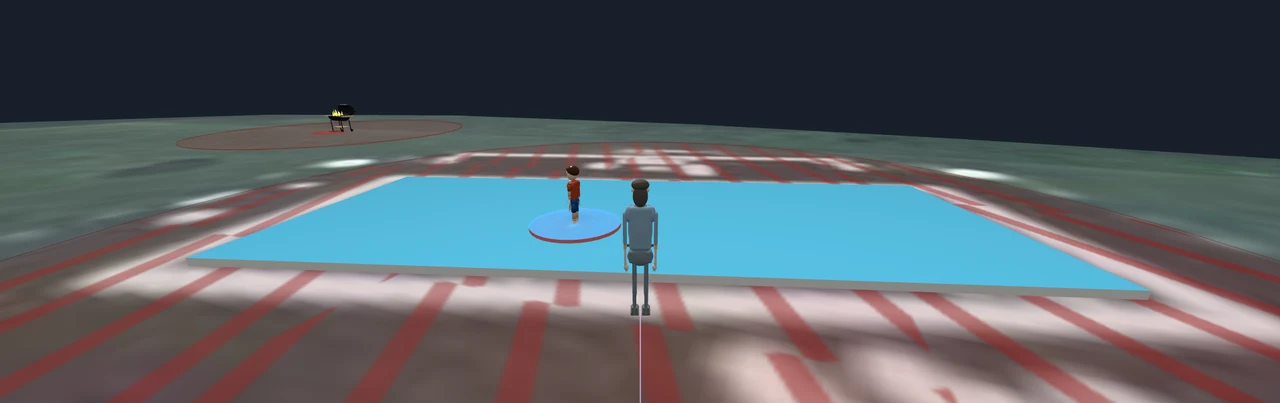
08:59:34 - the garden seen from above: the house, the pool and the barbecue; Henri is still in the house.09:00:50 - the barbecue is lit, and Paul walks away to the back of the garden.
Result08:59:48: the state of Martinez swimming pool goes to Open. 09:00:19: Martinez barbecue goes to On, its sensor climbing to 100 by 09:00:39. 09:00:55: Paul is at the back of the garden, 33 m from the barbecue. 09:00:57: Henri leaves the house and walks to the barbecue. The scene of r-iosemit, under the timeline, shows the zones as hatched ground.
03 · Step
Henri gets burned, then falls into the pool
Henri reaches the grill and comes within 1.5 m of it: the risk has become a fact. The first fork reads that the barbecue is on and takes the track Martinez barbecue On, where Henri walks to the edge of the pool; the second one reads that the pool is open.
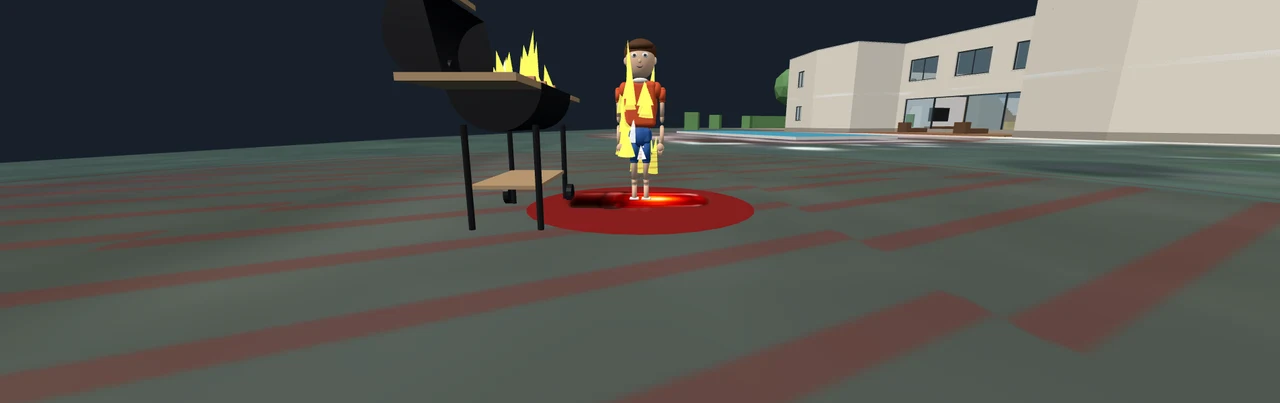
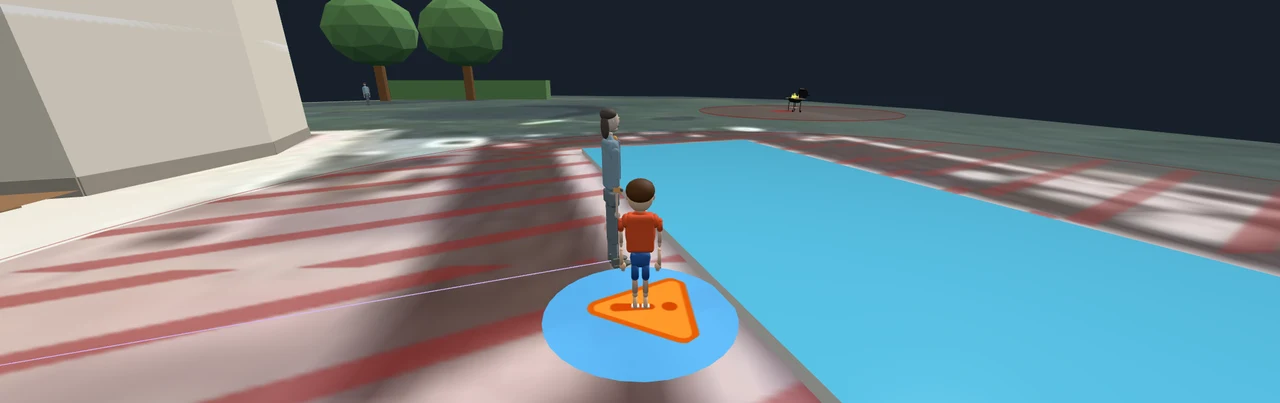
09:03:00 - Henri burns: he is in the state On fire, at the grill.
Result09:02:54: Henri burns is active and Henri goes to the state On fire. 09:02:55: the fork takes Martinez barbecue On. 09:03:12: Henri may drown at 99 %, at the edge of the pool. 09:03:13: the pool fork takes Martinez swimming pool Open. 09:03:22: Henri is in the water, Henri drowns is active and Henri is Wet.
04 · Step
The heart fails: the first ending
In the water, the watch plays a heart curve that falls from 87.6 to 71.7. The third fork reads that Henri is still inside the pool and takes its track, where the curve goes down to 0. The rules of the cardiac sensor follow it: the risk Henri may have bradycardia at 20 then 80 %, the alert Henri has bradycardia below 60, Henri may die at 90 % below 30, and Henri dies at 0.
Let the run play to its end.
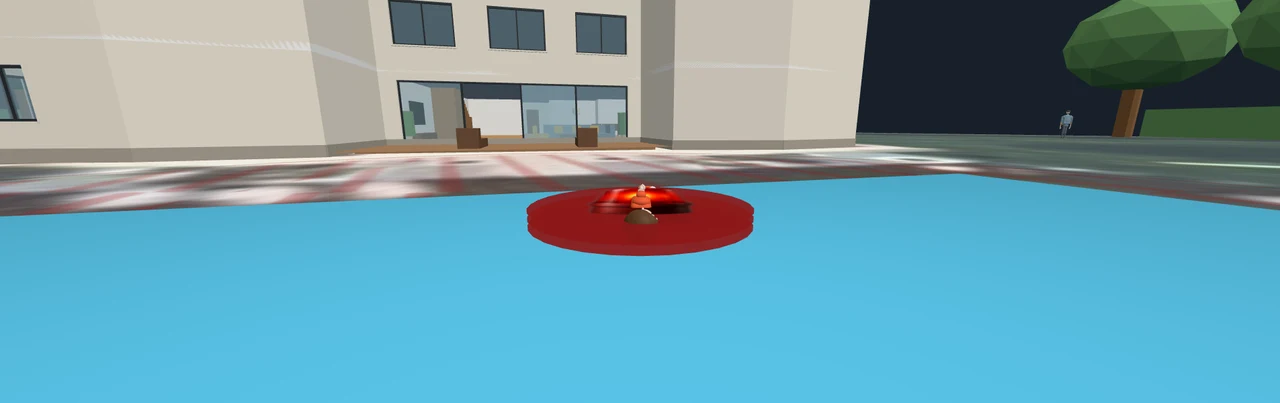
After 09:05:23 - the story is over: Henri lies dead in the open pool.
Result09:03:53: bradycardia risk at 20 %. 09:03:54: the fork takes Henri may have bradycardia. 09:04:03: 80 %. 09:04:13: Henri has bradycardia. 09:04:53: Henri may die at 90 %. 09:05:23: Henri dies, and Henri stays where he is, in the state Dead. No deduction, no task: the run is stored with its 18 key moments.
05 · Step
Second run: auto mode, Julie saves Henri
With the auto mode, each new alert is treated without a human: r-iota deduces a solution and deploys it. It acts on what it sees, the alerts on the field: without extrapolation, the burn is only seen at 1.5 m, too late to be avoided. For the pool, the deduction gives the task to the actor closest to what the problem impacts: Julie, who is in the kitchen, closer to the pool and to Henri than Paul.
In r-iosemit, click Restart: what was played is undone.
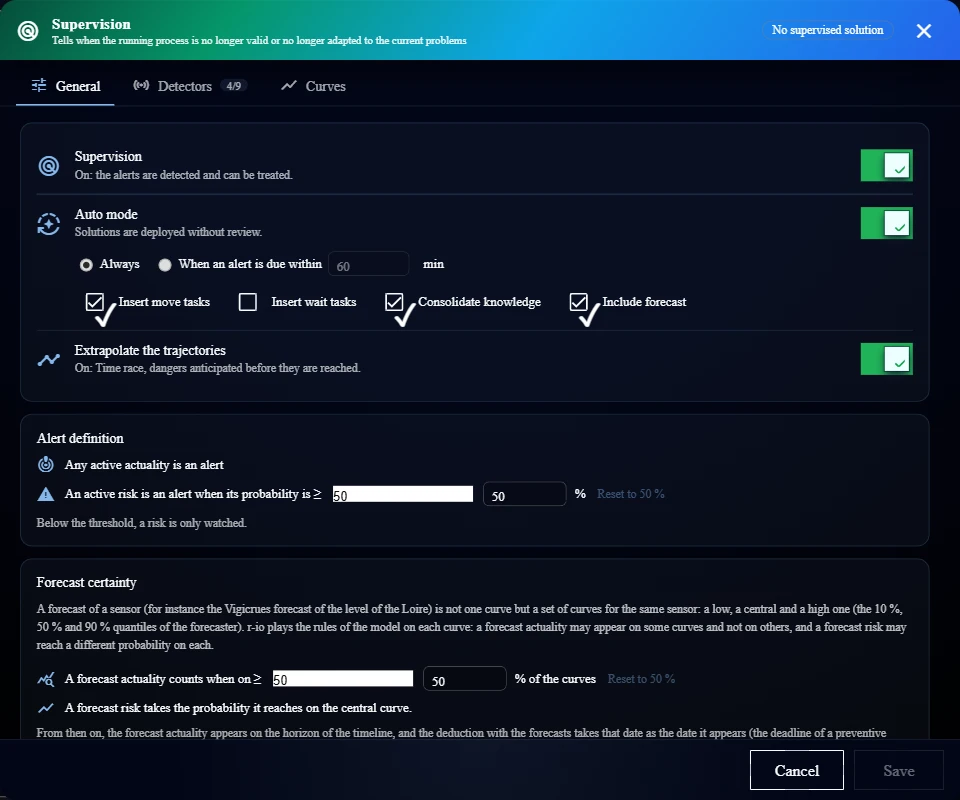
In the Supervision dialog of r-iota, turn Supervision and Auto mode on, tick Insert move tasks, Consolidate knowledge and Include forecast, leave Extrapolate the trajectories off, then click Save.
Click Play in r-iosemit, with the same options.
The Supervision dialog of r-iota, opened by the radar button of the toolbar (here with the settings of the third run).
Result09:02:54: Henri burns, and the barbecue fork takes Martinez barbecue On. 09:03:02: a deduction starts on the burn and the drowning risk. 09:03:22: Henri drowns; Solution_1_FIRST is deployed and Move to Martinez swimming pool goes to Julie. 09:03:43: a new deduction adapts the solution in progress: closing the pool is no longer of any use, and Close a pool is Ignored.
06 · Step
The rescue, then the cardiac massage
Julie reaches the pool and gets Henri out of the water. The heart fork has already taken its track; when the rescue is done, r-iosemit switches to Otherwise, since Henri is no longer in the pool. The heart rate stays low: the solution, adapted again, adds a cardiac massage.
Let the run play: the simulated actors accept and do their tasks on their own.
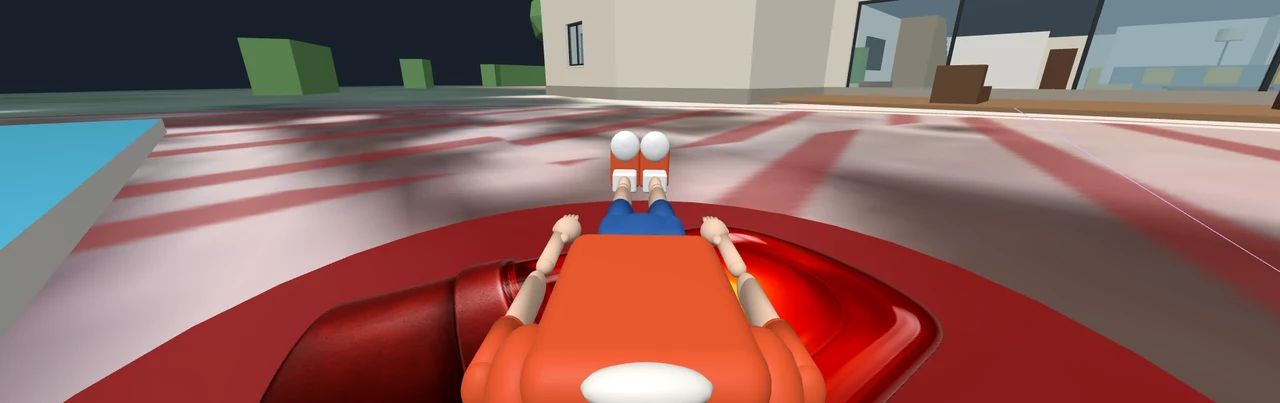
09:04:13 - Julie at the edge of the pool; Henri, still in the water, has bradycardia.09:04:33 - Henri is out of the water, lying on the edge: Julie starts the cardiac massage.09:05:36 - Henri stands again beside Julie: his heart rate is back to normal.
Result09:03:56: Julie is at the edge, and Rescue a child from drowning is accepted at 09:04:00. 09:04:13: Henri has bradycardia. 09:04:29: the rescue is done, Henri is out of the water, the heart fork goes to Otherwise and Henri drowns disappears. 09:04:33: Perform a cardiac massage is accepted; the heart rate climbs from 47.8 to 77.8. 09:05:35: the massage is done, Henri is Normal and the bradycardia is gone. Henri is alive at the end; the barbecue is still on.
07 · Step
Third run: extrapolation, nothing happens
Extrapolation gives r-io the trajectory of Henri: the rules can read how many seconds he needs to reach a zone. The burn risk then appears before Henri has entered the zone, the alert threshold of 50 % is crossed, and the auto mode acts ahead of the accident. This time the closest actor is Paul, at the back of the garden: he is closer to the barbecue than Julie. It is a race: Henri reaches the grill at 09:02:54.
Restart in r-iosemit, tick Extrapolate the trajectories in the Supervision dialog, click Save, then Play.
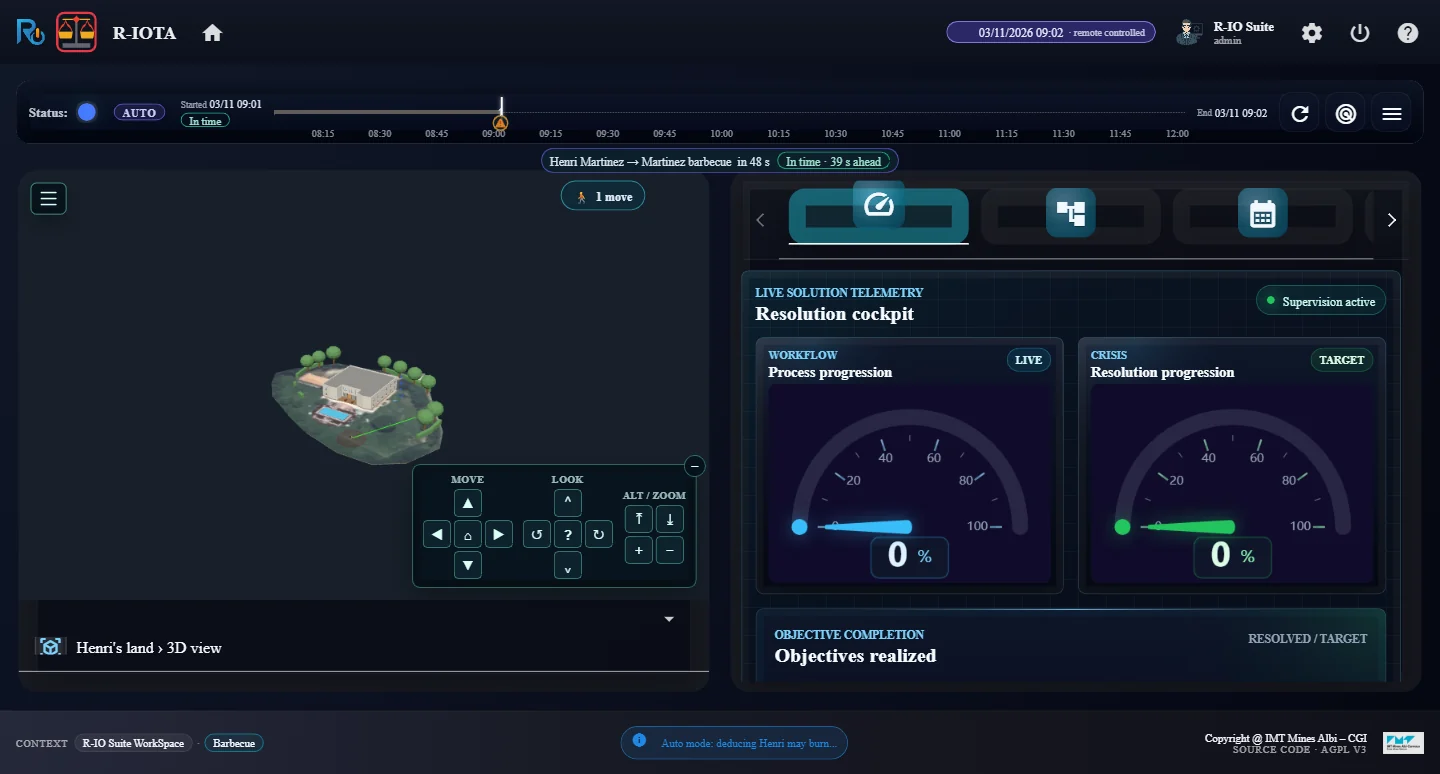
r-iota during the third run: under the supervision bar, the Time race card. Henri reaches the barbecue in 48 s, and the action of the plan ends 39 s before him (In time · 39 s ahead); one move is in progress.
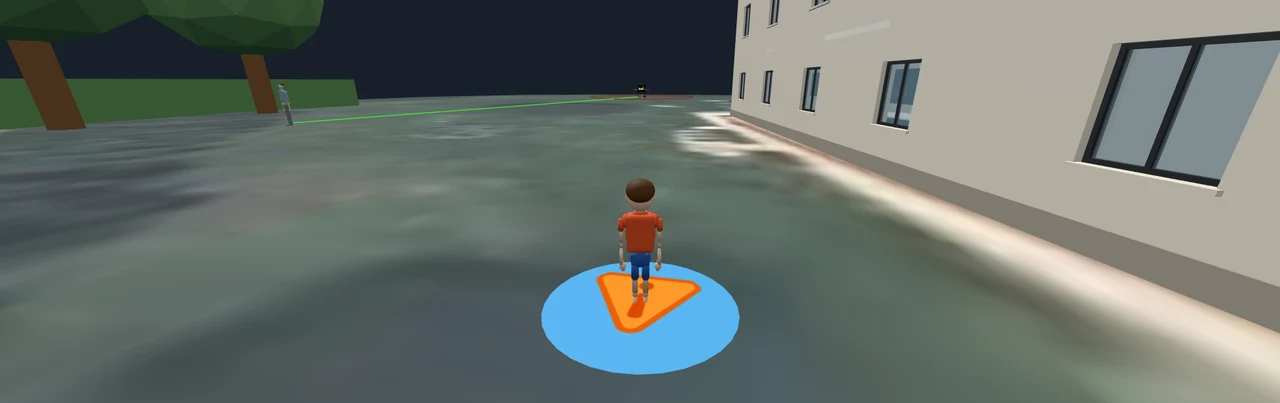
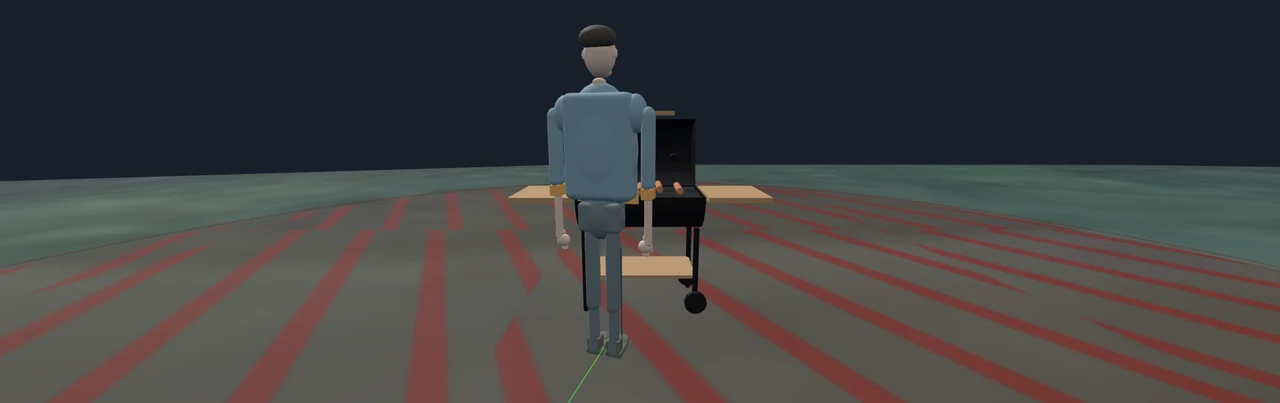
09:01:54 - Henri is still far from the barbecue, but the risk is already at 72 %: the solution has been deployed, and the path of Paul to the barbecue is drawn in red.09:02:14 - Paul walks to the barbecue along his path.After 09:02:24 - the barbecue is Off: no more flames; Paul stands beside it, and Henri is safe.
Result09:01:34: burn risk at 66 %, Henri being still out of the zone. 09:01:41: deduction. 09:01:44: solution deployed, Move to Martinez barbecue for Paul. 09:02:08: Paul is at the barbecue. 09:02:20: Extinguish a barbecue is done, the barbecue goes Off, the risk and the solution disappear. 09:02:55: the first fork finds a barbecue that is off and takes Otherwise: Henri burns never becomes active, and Henri never goes to the pool.
08 · Step
Compare the runs
While a run goes on, r-iosemit reads r-io every two seconds, as any observer of the field could, and notes each key moment with the clock of the use case and with the settings of the supervision. The run goes from Play to the next Restart or to the end of the story.
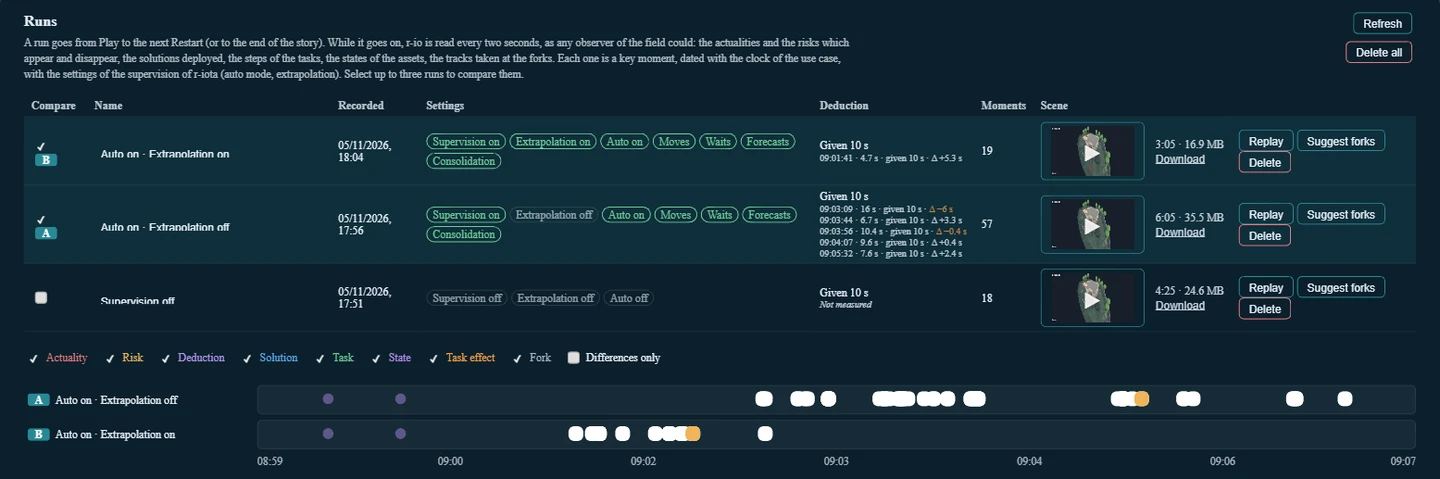
Open the RUNS mode of r-iosemit: each run has its name, its settings as badges, its deduction times, its number of moments and, when Film the runs was ticked under the scene, its video in the Scene column.
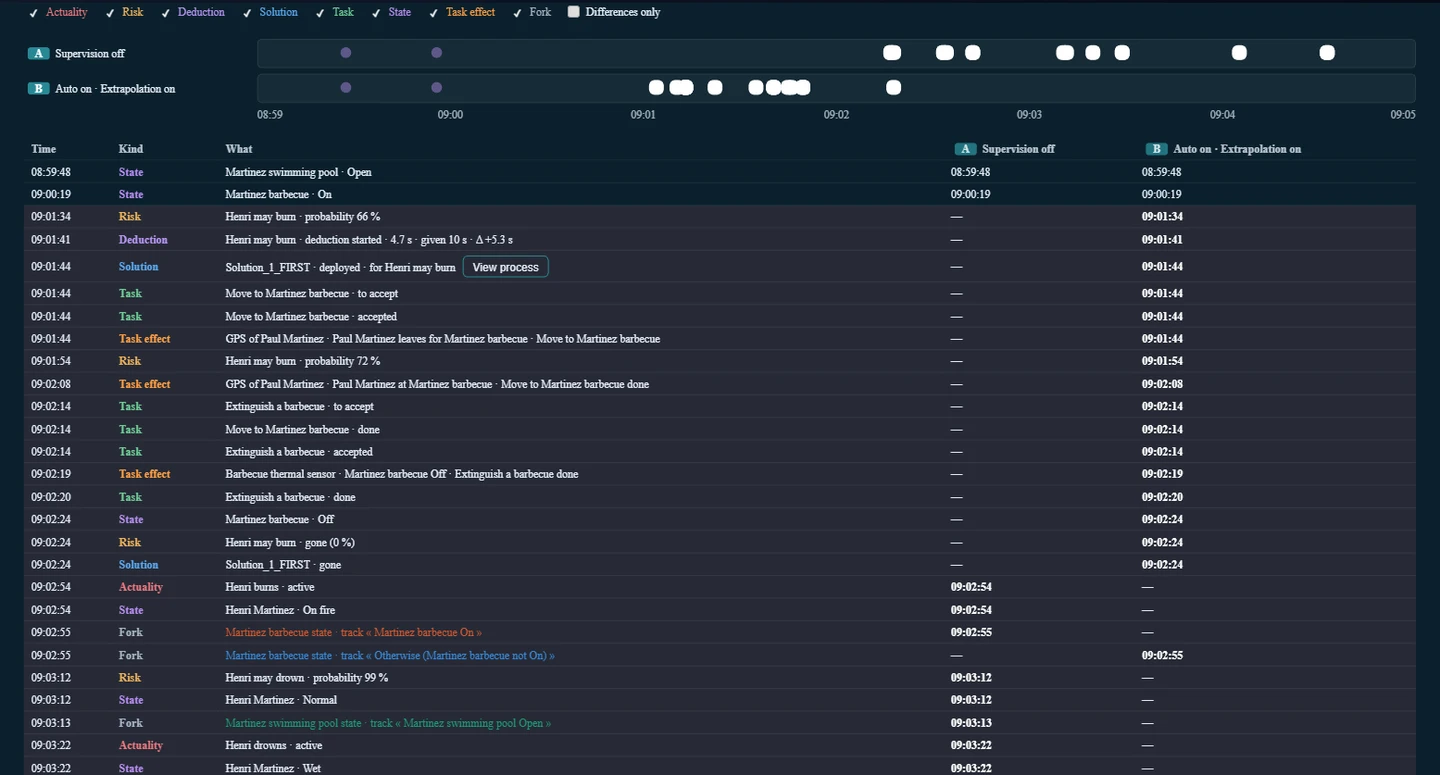
Tick the first run, then the third one, in the Compare column, then filter by kind of moment or tick Differences only.
The three reference runs with their settings, their deduction times, their moments and their videos.Without supervision (A) and with extrapolation (B): the moments of each run, in bold when only one of them has it.
ResultThe lanes show the moments side by side, then the table lists them by date. The comparison reads as an answer: in B, the risk, the deduction, the solution, the move of Paul and the extinction take place between 09:01:34 and 09:02:24; in A, there is nothing at these dates, and Henri burns appears at 09:02:54.
09 · Step
Replay a run
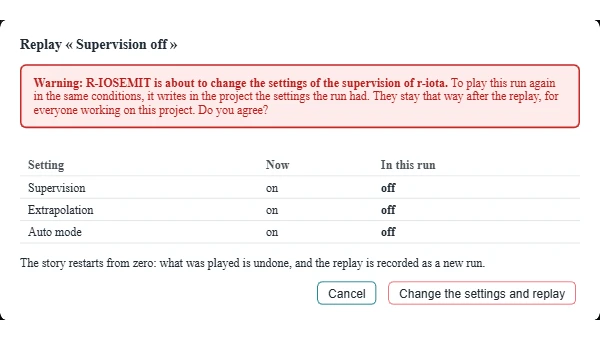
A run keeps the settings it was played with. To play it again in the same conditions, these settings must be written back in the project. r-iosemit only reads r-io: this is the one exception, and it asks first.
In the RUNS mode, click Replay on a run whose settings differ from the current ones.
Read the warning and the table of settings, then click Change the settings and replay, or Cancel.
The warning before replaying the first run: the settings that are about to change, for everyone working on this project.
ResultThe story restarts from zero: what was played is undone, the settings of the run stay in place after the replay, and the replay is recorded as a new run.
Going further
Behind the scenes: rules and forks
The burn risk is not written by hand any more: High Temperature induces the model risk A Kid burns, about the role Kid that Henri has, and r-io suite generates the risk A Kid burns: Henri Martinez (Martinez barbecue) with the rule below, written on the Is_Susceptible_To of the role and copied on Henri’s (see the causal chain). Inside the 6 m zone, the probability follows the distance to the barbecue, from 0 at the edge to 0.95 at the contact distance of 1 m, then 1. Outside, secondsToReach tells how many seconds Henri needs to reach the zone at his current speed; it reads −1 when Henri does not head for it or when extrapolation is off, and the probability then goes from 0.5 to 0.9 as the deadline of 120 s gets closer. With an alert threshold of 50 %, that is what lets r-iota act before the accident. The step results above were recorded before this rule was generated, with the risk names of that time.
A fork is a date and a list of tracks in the scenario: each track holds a condition read in r-io (the state of a resource or its position; a status or the end of a task on forks saved earlier) and its own sensor values. The first track whose condition holds is played, and the Otherwise track is played when none does. r-iosemit never writes in the model during a run: all it changes goes through the sensors, like a real field. That is why the same story can follow what r-iota really did.
Un jardin, une histoire, trois fins. Un enfant, Henri, marche vers un barbecue allumé, puis vers une piscine ouverte. r-iosemit joue l’histoire et ne fait que lire l’état du terrain pour choisir ses pistes ; r-iota, selon son réglage, ne fait rien, réagit aux alertes ou les anticipe. Joué trois fois, le même scénario se termine par la mort de l’enfant, par un enfant sauvé par sa mère ou par un accident qui n’arrive jamais, et r-iosemit compare les runs.
Ce que montre ce scénario
L’histoire n’est pas une liste figée d’événements. Elle contient des fourches : à une date donnée, r-iosemit lit dans r-io l’état d’une ressource ou la position d’une personne et prend la piste correspondante. Rien n’indique à l’histoire ce que r-iota a décidé : elle voit seulement ce qui s’est passé sur le terrain. Si le barbecue a été éteint, Henri ne se brûle pas, car la piste où il se brûle n’est pas prise.
Côté r-io, tout est déduit des capteurs par des règles 2L et des règles CEP : zones de danger, risques dont la probabilité suit la distance, puis alertes. Avec le mode auto, r-iota traite chaque nouvelle alerte sans humain et confie chaque tâche à l’acteur le plus proche ; avec l’extrapolation, il voit venir le danger d’après la trajectoire d’Henri, avant qu’il n’y soit.
Les heures ci-dessous sont celles des trois runs de référence livrés avec le scénario : compter quelques secondes d’écart d’un run à l’autre.
01 · Étape
Ouvrir le projet et lire le scénario
Le projet Barbecue modélise un jardin : une maison, un barbecue muni d’un capteur thermique, une piscine dont la couverture a un capteur, les parents Paul et Julie, et leur enfant Henri, qui porte un téléphone avec un GPS et une montre avec un capteur de rythme cardiaque. L’histoire part d’un tronc commun, puis se divise trois fois, chaque fourche dans une piste de la précédente.
Dans r-ioga, charger Barbecue depuis le Projects workspace, puis ouvrir Project List.
Lancer r-iosemit et r-iota depuis la colonne Applications de la ligne du projet, et les garder ouverts pendant tout le scénario.
Dans r-iosemit, choisir le scénario de jeu Henri Barbecue Story, ouvrir le mode TIMELINE et sa vue en arbre.
L’arbre du scénario : le tronc, puis trois fourches imbriquées (losanges), chacune avec sa piste et sa piste Otherwise.
RésultatLa frise va de 08:59:28 à 09:05:53, sans arrêt. Trois questions décident de la fin : à 09:02:55, Martinez barbecue state (le barbecue est-il allumé ?) ; à 09:03:13, Martinez swimming pool state (la piscine est-elle ouverte ?) ; à 09:03:54, Henri may have bradycardia (Henri est-il dans la piscine ?). Le mode RUNS contient déjà les trois runs de référence.
02 · Étape
Premier run : personne ne surveille
Sans supervision, r-io calcule toujours les risques et les alertes, mais personne n’y donne suite. Paul quitte le salon, ouvre la couverture de la piscine, allume le barbecue, puis part au fond du jardin. Le barbecue est On dès que son capteur thermique dépasse 0 : chaque état déclare l’effet observé sur le terrain, et r-io en déduit l’état. Les règles posent une zone de danger de 6 m autour du barbecue allumé et de 10 m autour de la piscine ouverte.
Dans r-iota, cliquer sur le bouton radar de la barre d’outils : la boîte Supervision s’ouvre. Désactiver Supervision et cliquer sur Save.
Dans r-iosemit, cliquer sur Play : nommer le run, choisir Continuous à ×1440, un Deduction and deployment time donné à 10 s, et cocher Simulated actors do their tasks on their own.
08:59:34 - le jardin vu d’en haut : la maison, la piscine et le barbecue ; Henri est encore dans la maison.09:00:50 - le barbecue est allumé, et Paul s’éloigne vers le fond du jardin.
Résultat08:59:48 : l’état de Martinez swimming pool passe à Open. 09:00:19 : Martinez barbecue passe à On, son capteur montant à 100 jusqu’à 09:00:39. 09:00:55 : Paul est au fond du jardin, à 33 m du barbecue. 09:00:57 : Henri sort de la maison et marche vers le barbecue. La scène de r-iosemit, sous la frise, montre les zones en hachures au sol.
03 · Étape
Henri se brûle, puis tombe dans la piscine
Henri atteint la grille et s’en approche à moins de 1,5 m : le risque est devenu un fait. La première fourche lit que le barbecue est allumé et prend la piste Martinez barbecue On, où Henri marche jusqu’au bord de la piscine ; la deuxième lit que la piscine est ouverte.
09:03:00 - Henri se brûle : il est dans l’état On fire, à la grille.
Résultat09:02:54 : Henri burns est active et Henri passe dans l’état On fire. 09:02:55 : la fourche prend Martinez barbecue On. 09:03:12 : Henri may drown à 99 %, au bord de la piscine. 09:03:13 : la fourche de la piscine prend Martinez swimming pool Open. 09:03:22 : Henri est dans l’eau, Henri drowns est active et Henri est Wet.
04 · Étape
Le cœur lâche : première fin
Dans l’eau, la montre joue une courbe cardiaque qui descend de 87,6 à 71,7. La troisième fourche lit qu’Henri est toujours dans la piscine et prend sa piste, où la courbe descend jusqu’à 0. Les règles du capteur cardiaque la suivent : le risque Henri may have bradycardia à 20 puis 80 %, l’alerte Henri has bradycardia sous 60, Henri may die à 90 % sous 30, et Henri dies à 0.
Laisser le run aller jusqu’au bout.
Après 09:05:23 - l’histoire est finie : Henri gît, mort, dans la piscine ouverte.
Résultat09:03:53 : risque de bradycardie à 20 %. 09:03:54 : la fourche prend Henri may have bradycardia. 09:04:03 : 80 %. 09:04:13 : Henri has bradycardia. 09:04:53 : Henri may die à 90 %. 09:05:23 : Henri dies, et Henri reste où il est, dans l’état Dead. Aucune déduction, aucune tâche : le run est enregistré avec ses 18 moments clés.
05 · Étape
Deuxième run : mode auto, Julie sauve Henri
Avec le mode auto, chaque nouvelle alerte est traitée sans humain : r-iota déduit une solution et la déploie. Il agit sur ce qu’il voit, les alertes du terrain : sans extrapolation, la brûlure n’est vue qu’à 1,5 m, trop tard pour l’éviter. Pour la piscine, la déduction confie la tâche à l’acteur le plus proche de ce que touche le problème : Julie, qui est à la cuisine, plus près de la piscine et d’Henri que Paul.
Dans r-iosemit, cliquer sur Restart : ce qui a été joué est défait.
Dans la boîte Supervision de r-iota, activer Supervision et Auto mode, cocher Insert move tasks, Consolidate knowledge et Include forecast, laisser Extrapolate the trajectories désactivé, puis cliquer sur Save.
Cliquer sur Play dans r-iosemit, avec les mêmes options.
La boîte Supervision de r-iota, ouverte par le bouton radar de la barre d’outils (ici avec les réglages du troisième run).
Résultat09:02:54 : Henri burns, et la fourche du barbecue prend Martinez barbecue On. 09:03:02 : une déduction démarre sur la brûlure et le risque de noyade. 09:03:22 : Henri drowns ; Solution_1_FIRST est déployée et Move to Martinez swimming pool va à Julie. 09:03:43 : une nouvelle déduction adapte la solution en cours : fermer la piscine ne sert plus à rien, et Close a pool est Ignored.
06 · Étape
Le sauvetage, puis le massage cardiaque
Julie arrive à la piscine et sort Henri de l’eau. La fourche du cœur a déjà pris sa piste ; quand le sauvetage est fait, r-iosemit passe sur Otherwise, puisqu’Henri n’est plus dans la piscine. Le rythme cardiaque reste bas : la solution, adaptée de nouveau, ajoute un massage cardiaque.
Laisser le run se jouer : les acteurs simulés acceptent et font leurs tâches d’eux-mêmes.
09:04:13 - Julie au bord de la piscine ; Henri, encore dans l’eau, est en bradycardie.09:04:33 - Henri est sorti de l’eau, allongé sur le bord : Julie commence le massage cardiaque.09:05:36 - Henri est de nouveau debout à côté de Julie : son rythme cardiaque est redevenu normal.
Résultat09:03:56 : Julie est au bord, et Rescue a child from drowning est acceptée à 09:04:00. 09:04:13 : Henri has bradycardia. 09:04:29 : le sauvetage est fait, Henri est hors de l’eau, la fourche du cœur passe sur Otherwise et Henri drowns disparaît. 09:04:33 : Perform a cardiac massage est acceptée ; le rythme remonte de 47,8 à 77,8. 09:05:35 : le massage est fait, Henri est Normal et la bradycardie a disparu. Henri est vivant à la fin ; le barbecue est toujours allumé.
07 · Étape
Troisième run : extrapolation, rien n’arrive
L’extrapolation donne à r-io la trajectoire d’Henri : les règles peuvent lire en combien de secondes il atteindra une zone. Le risque de brûlure apparaît alors avant qu’Henri soit entré dans la zone, le seuil d’alerte de 50 % est franchi, et le mode auto agit avant l’accident. Cette fois l’acteur le plus proche est Paul, au fond du jardin : il est plus près du barbecue que Julie. C’est une course : Henri atteint la grille à 09:02:54.
Restart dans r-iosemit, cocher Extrapolate the trajectories dans la boîte Supervision, cliquer sur Save, puis Play.
r-iota pendant le troisième run : sous la barre de supervision, la carte Time race. Henri atteint le barbecue dans 48 s, et l’action du plan finit 39 s avant lui (In time · 39 s ahead) ; un déplacement est en cours.
09:01:54 - Henri est encore loin du barbecue, mais le risque est déjà à 72 % : la solution a été déployée, et le trajet de Paul jusqu’au barbecue est tracé en rouge.09:02:14 - Paul marche vers le barbecue en suivant son trajet.Après 09:02:24 - le barbecue est Off : plus de flammes ; Paul est à côté, et Henri est sain et sauf.
Résultat09:01:34 : risque de brûlure à 66 %, Henri étant encore hors de la zone. 09:01:41 : déduction. 09:01:44 : solution déployée, Move to Martinez barbecue pour Paul. 09:02:08 : Paul est au barbecue. 09:02:20 : Extinguish a barbecue est faite, le barbecue passe à Off, le risque et la solution disparaissent. 09:02:55 : la première fourche trouve un barbecue éteint et prend Otherwise : Henri burns ne devient jamais active, et Henri ne va jamais à la piscine.
08 · Étape
Comparer les runs
Pendant un run, r-iosemit lit r-io toutes les deux secondes, comme le ferait tout observateur du terrain, et note chaque moment clé avec l’horloge du cas d’usage et les réglages de la supervision. Le run va du Play au Restart suivant ou à la fin de l’histoire.
Ouvrir le mode RUNS de r-iosemit : chaque run a son nom, ses réglages en pastilles, ses temps de déduction, son nombre de moments et, quand Film the runs était coché sous la scène, sa vidéo dans la colonne Scene.
Cocher le premier run, puis le troisième, dans la colonne Compare, puis filtrer par type de moment ou cocher Differences only.
Les trois runs de référence avec leurs réglages, leurs temps de déduction, leurs moments et leurs vidéos.Sans supervision (A) et avec extrapolation (B) : les moments de chaque run, en gras quand un seul des deux l’a.
RésultatLes lignes montrent les moments côte à côte, puis le tableau les liste par date. La comparaison se lit comme une réponse : en B, le risque, la déduction, la solution, le déplacement de Paul et l’extinction ont lieu entre 09:01:34 et 09:02:24 ; en A, rien à ces dates, et Henri burns apparaît à 09:02:54.
09 · Étape
Rejouer un run
Un run garde les réglages avec lesquels il a été joué. Pour le rejouer dans les mêmes conditions, il faut réécrire ces réglages dans le projet. r-iosemit ne fait que lire r-io : c’est la seule exception, et il demande d’abord.
Dans le mode RUNS, cliquer sur Replay sur un run dont les réglages diffèrent des réglages actuels.
Lire l’avertissement et le tableau des réglages, puis cliquer sur Change the settings and replay, ou sur Cancel.
L’avertissement avant de rejouer le premier run : les réglages qui vont changer, pour tous ceux qui travaillent sur ce projet.
RésultatL’histoire repart de zéro : ce qui a été joué est défait, les réglages du run restent en place après le rejeu, et le rejeu est enregistré comme un nouveau run.
Pour aller plus loin
En coulisses : règles et fourches
Le risque de brûlure n’est plus écrit à la main : High Temperature induit le risque modèle A Kid burns, sur le rôle Kid qu’Henri a, et r-io suite génère le risque A Kid burns: Henri Martinez (Martinez barbecue) avec la règle ci-dessous, écrite sur le Is_Susceptible_To du rôle et recopiée sur celui d’Henri (voir la chaîne causale). Dans la zone de 6 m, la probabilité suit la distance au barbecue, de 0 au bord à 0,95 à la distance de contact de 1 m, puis 1. Hors de la zone, secondsToReach donne le nombre de secondes qu’il faut à Henri pour atteindre la zone à sa vitesse actuelle ; il vaut −1 quand Henri ne s’y dirige pas ou quand l’extrapolation est désactivée, et la probabilité va alors de 0,5 à 0,9 à mesure que l’échéance de 120 s approche. Avec un seuil d’alerte de 50 %, c’est ce qui permet à r-iota d’agir avant l’accident. Les résultats des étapes ci-dessus ont été enregistrés avant que cette règle soit générée, avec les noms de risques de l’époque.
Une fourche est une date et une liste de pistes dans le scénario : chaque piste porte une condition lue dans r-io (l’état d’une ressource ou sa position ; un statut ou la fin d’une tâche sur les fourches enregistrées avant) et ses propres valeurs de capteurs. La première piste dont la condition est vraie est jouée, et la piste Otherwise l’est quand aucune ne l’est. r-iosemit n’écrit jamais dans le modèle pendant un run : tout ce qu’il change passe par les capteurs, comme un vrai terrain. C’est pour cela que la même histoire peut suivre ce que r-iota a réellement fait.